

ACMT Activities at #NACCT2026
Schedule
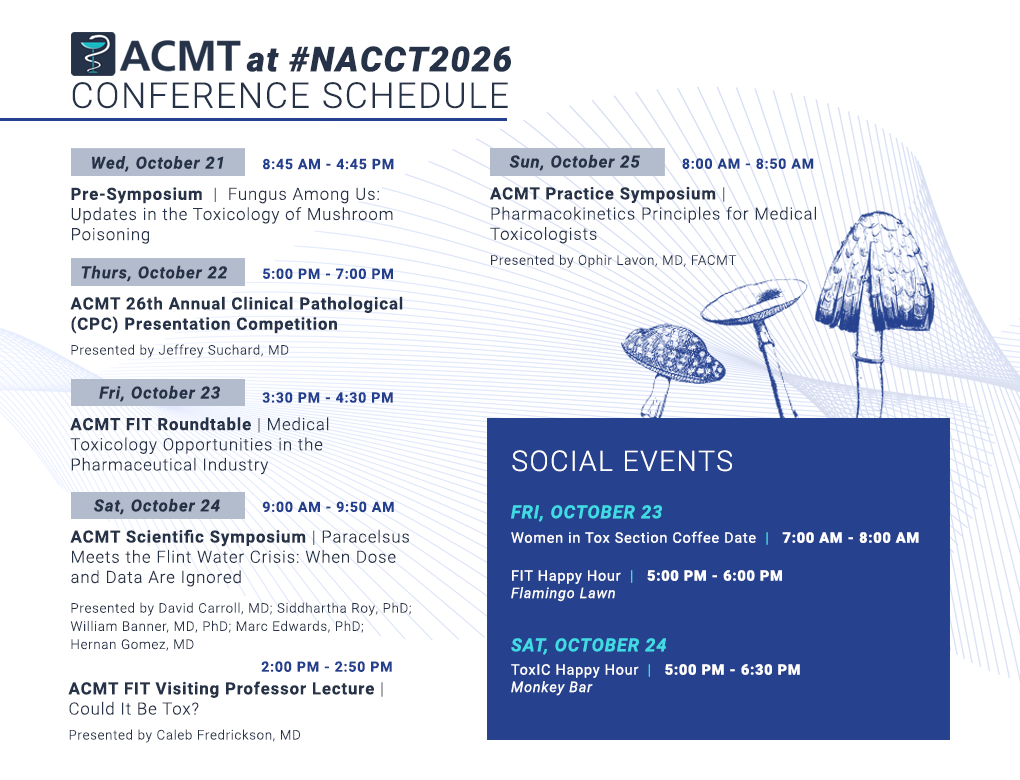
ACMT Pre-Symposium
Wed. October 21
ACMT 27th Annual Clinical Pathological (CPC) Presentation Competition
Thu. October 22
Women in Tox Section Coffee Date
Fri. October 23
ACMT FIT Roundtable
Fri. October 23
Fellowship Directors Meeting
Fri. October 23
FIT Happy Hour
Fri. October 23
ACMT Scientific Symposium | Paracelsus Meets the Flint Water Crisis: When Dose and Data Are Ignored
Sat. October 24
ACMT FIT Visiting Professor Lecture | Could It Be Tox?
Sat. October 24
ToxIC Happy Hour
Sat. October 24
Association of Medical Toxicology Division and Section Chiefs Meeting
Sat. October 24
ACMT Practice Symposium | Pharmacokinetics Principles for Medical Toxicologists
Sun. October 25
ACMT Activities at #NACCT2026
Join ACMT at the 2026 North American Congress of Clinical Toxicology (NACCT) in San Diego from October 21-25, 2026.
In addition to the Fungus Among Us: Updates in the Toxicology of Mushroom Poisoning on Wednesday, October 21st, ACMT will participate in a number of other activities and programming throughout #NACCT2026.
Main Conference Activities
Thursday, October 22 • 5:00 PM – 7:00 PM
ACMT 26th Annual Clinical Pathological (CPC) Presentation Competition
- Jeffrey Suchard, MD, Professor of Clinical Emergency Medicine & Associate Dean for Basic Science Education, University of California, Irvine (Moderator)
Description
Now in its 27th year, ACMT’s Clinical Pathological Case (CPC) Competition is a highlight of NACCT, where selected mentor/mentee teams present and solve complex, real-world toxicology cases in front of a live audience. Each discussant is challenged to walk through a clinical differential diagnosis without knowing the final outcome in advance. Submissions are welcome from across specialties—including Emergency Medicine, Pediatrics, Occupational Medicine, and Pharmacy—as long as the senior team member is an ACMT Member with an academic supervisory role. This fast-paced session blends clinical reasoning, toxicologic expertise, and educational insight into an engaging and suspenseful competition.
Friday, October 23 • 7:00 AM – 8:00 AM
Women in Tox Section Coffee Date
Join Women in Tox for coffee on us at American College of Medical Toxicology ASM in San Diego!
We’re gathering at The MKT for a relaxed hour of caffeine, connection, and conversation. Whether you’re new to the group or have been part of the community for years, we’d love to see you there. If you’ll be at NACCT, this is the perfect chance to pause, recharge, and catch up.
Coffee’s on us. Just bring yourself
Friday, October 23 • 3:30 PM – 4:30 PM
ACMT FIT Roundtable | Medical Toxicology Opportunities in the Pharmaceutical Industry
- Speaker Information Coming Soon!
Description
This interactive roundtable will introduce fellows-in-training and early-career medical toxicologists to career opportunities within the pharmaceutical industry. Faculty with industry experience will discuss the diverse roles available to medical toxicologists, explore the unique benefits and challenges of working in this setting, and share insights into how industry careers differ from traditional clinical and academic pathways. Attendees will gain practical advice on preparing for and pursuing positions in the pharmaceutical industry, as well as strategies for exploring this growing and evolving career path.
Learning Objectives
1. Introduce opportunities for medical toxicologists in the pharmaceutical industry.
2. Discuss the benefits and difficulties of work in this industry.
3. Provide ideas for how to pursue this career path if interested.
Friday, October 23 • 4:30 PM – 6:00 PM
Fellowship Directors Meeting | Palm 1/2
Friday, October 23 • 5:00 PM – 6:00 PM
FIT Happy Hour | Martini Lawn
Three reasons you shouldn’t miss this FIT Happy Hour:
Free drinks.
Your first round is on us.
Perfect location.
Right near the Conference Center, an easy spot to drop in and unwind.
The best company.
Connect with fellow FITs, swap stories, and enjoy time together outside the meeting rooms.
Join us to relax, recharge, and make the most of NACCT. We hope to see you there.
Saturday, October 24 • 9:00 – 9:50 AM
ACMT Scientific Symposium | Paracelsus Meets the Flint Water Crisis: When Dose and Data Are Ignored
- Moderator: David Carroll, MD, Toxicologist, Michigan Poison & Drug Information Center, Detroit Medical Center
- Siddhartha Roy, PhD, Assistant Professor of Environmental Sciences, Rutgers University
- William Banner, MD, PhD, University of Oklahoma; Past President, American Association of Poison Control Centers
- Marc Edwards, PhD, Professor of Environmental Sciences, Virginia Tech
- Hernan Gomez, MD, Associate Professor of Emergency Medicine, University of Michigan
Description
Ten years after the Flint Water Crisis emerged as a national flashpoint at the intersection of environmental toxicology, media, and public advocacy, its scientific and communication lessons remain highly relevant. While early investigative work appropriately identified infrastructure failures and regulatory violations, subsequent public narratives often departed from foundational toxicologic principles, particularly the importance of dose, exposure, and population-level context.
This session will examine how selective interpretation of data and amplification through media channels contributed to narratives that were not consistently supported by surveillance data, including blood lead measurements and evidence regarding neurologic outcomes in children and reported fetal effects. Using Flint as a case study, this didactic symposium will explore how toxicologists can critically appraise evolving public health narratives and engage more effectively in risk communication. Attendees will gain practical strategies for maintaining scientific rigor in public discourse while navigating the complex interface between science, media, and advocacy.
Learning Objectives
1. Describe how departures from core toxicologic principles (e.g., dose–response, exposure assessment) influenced public messaging during the Flint Water Crisis.
2. Evaluate the clinical, educational, and public health consequences of distorted scientific communication, including long term effects on public trust in scientific expertise.
3. Analyze how media amplification and advocacy narratives can diverge from population-level toxicologic data.
Saturday, October 24 • 2:00 PM – 2:50 PM
ACMT FIT Visiting Professor Lecture | Could It Be Tox?
- Caleb Fredrickson, MD, Washington University in St. Louis
Description
This session explores the value of (Could It Be Tox) CIBT consults, or cases where toxicology is asked to evaluate unexplained organ dysfunction without a clear exposure history. Through these challenging scenarios, participants will learn how to expand their differential diagnosis, consider rare toxicologic causes, and guide clinical teams toward more efficient and cost-effective evaluations. The session also highlights how these consults strengthen interdisciplinary relationships and reinforce the role of toxicologists as key problem-solvers in complex clinical cases.
Learning Objectives
1. Develop a systematic approach to expanding the differential diagnosis in cases of unexplained organ dysfunction, including consideration of rare and atypical toxicologic exposures.
2. Identify opportunities to guide clinical teams away from unnecessary or invasive diagnostic workups and toward more efficient, cost-effective evaluation strategies.
3. Recognize the role of medical toxicologists in interdisciplinary collaboration and relationship-building to enhance trust, consultation utilization, and patient care outcomes.
Sunday, October 25 • 8:00 AM – 8:50 AM
ACMT Practice Symposium | Pharmacokinetics Principles for Medical Toxicologists
- Ophir Lavon, MD, FEAPCCT, FACMT, Head, Clinical Pharmacology and Toxicology, Carmel Medical Center
Description
This session will provide a practical introduction to pharmacokinetic (PK) principles essential for medical toxicologists and their evolving clinical practice. Designed for clinicians looking to strengthen applied toxicology skills, the presentation will review key PK concepts, demonstrate clinically relevant calculations, and explore case-based applications that support interpretation and management of poisoning scenarios. Attendees will gain practical tools to enhance bedside decision-making and expand their understanding of how pharmacokinetics informs modern toxicology practice.
Learning Objectives
1. Define and explain key PK terms.
2. Learn basic PK calculations relevant to clinical scenarios.
3. Understand PK principles to interpret and manage poisonings.